

🌡️The heat issue
An edition for when it's too hot to do anything. And how creativity helps us imagine better futures.



👋 Dear creative. How are you doing today?
Well, the heatwave is gradually cooling down. It is still recent, and we started feeling its effects yesterday, more than 10 degrees down. For all those like me in Europe, particularly in France, we have just gone through a brutal but necessary ecological awakening. We are entering the least hot summer of the rest of our lives*. Let that sink in for a moment.
*A spot-on sentence I heard from the filmmaker Vincent Verzat.
Summer heat is cool most of the time… until it demands coldness
Summer is such a vibe. Everyone looks forward to warmer temperatures and a slower pace. Some live a summer-all-year-round mindset and lifestyle. In contrast, others spend the rest of the year preparing to make the most of those two precious months. They compound energy to carry them through the back-to-school season.
Summer has a special place in our collective imagination as the season of leisure. But that imagery is shifting toward something else: adapting to extreme heat. We enjoy warmth when it feels comfortable and doesn’t get in the way of our plans. Beyond that, we have no control over the weather. We can only adapt.
As temperatures hit +40°C day after day, we discover a burning desire for freshness. Sometimes, even for survival. It is quite a shift! Yet many cultures have learned to thrive in scorching heat, and perhaps they have one or two lessons to teach us.
🎈Heatwave thoughts…
❇️ No patience, energy to do anything!
A heatwave demands some patience... to do the things you want to do. It asks for adaptation. Working early in the morning. Exercising before the sun takes over. Saving slower, more meditative moments for the fresher hours of the day. When it is +40°C, your mind either slows down or races because of the heat. Your body asks for care to keep going. Specific foods to counter the temperature, added to sweet temptations to balance (those ice creams…).Your tech tools or devices become hot, imposing a pause. Creativity begins to rise in unexpected places. Everything becomes about finding new ways to cool down, restore your energy, and return to some sense of normalcy, if you can. Any breath of cold air is the new oil.
❇️ Equip yourself as you can and do not judge…
A few days ago in France, a TV presenter mocked people living in rooftop apartments in Paris, saying they should not complain because, rich or poor, everyone suffers during a heatwave. The backlash revealed a lot about privilege and how little attention is paid to the living conditions many people endure. Rooftop apartments, especially the chambres de bonne, become Fahrenheit 451 bubbles during extreme heat. They are simply unbearable. At least this controversy put the spotlight where it belonged: on what people are really going through.❇️ Survival, adaptation, release, freedom, rebel energy
Air conditioning units are out of stock, with weeks before availability. As people prepare, mentally and practically, for another heatwave (in a week or so), governments and public institutions are beginning to realize that many people are not equipped for these conditions. Despite decades of warnings, it feels as if the message just aired for the first time yesterday.Climate change is not a rumour. It is not far from home. It is not happening only in Africa or Asia. It is here. It is there. It is everywhere. It is now.
If we do not want to live on a planet that turns against us, its tenants, we must change the narrative, adapt, and make amends. This is a collective wake-up call. And I hope we find the courage to put the people, systems, and policies in place before the cost of inaction becomes even greater. Because if not, intentional rebellion follows.
❇️ Watering humans or cooling data centers?
Europe has more than 3000 data centers. The three leading countries are the United Kingdom (500+), Germany (500+), and France (300+). No shaming, just information. With increasingly frequent and intense heatwaves across Europe, and the significant amount of water many data centers require for cooling,
I cannot help but wonder whether, one day, we will have to ask a difficult question: Prioritize people or data centers? It is an obvious answer, yet let’s stay alert.
The best gift we can give to our children is a greener future. We don’t need to give them anything special.
Bhuwan Thapaliya

☕ Grab some tea or coffee, and let’s go!
Oh! Artists: Creative inventiveness to absorb heat.
Creative (proactivity) awe.
Spark that heat in the body.
✦ Did you miss the last post? We had a guest essay about the body keeping a creative score.

🎨 Creative inventiveness to absorb heat


✦ Architecture offers ways out of the scorching heat
More than a decade ago, while working in the cultural sector, and more specifically in architecture, I came across remarkable projects and innovations by architects and collectives rethinking how we build our cities. They were paving the way for a more mindful use of materials to reduce heat, mitigate the effects of climate change, and explore new organic materials designed for people by people.
One of the architects who has stayed with me over the years is Diébédo Francis Kéré. His work proves that meaningful architecture does not begin with expensive materials. It begins with people. Using innovative materials available within local communities and bioclimatic designs, he creates wonder. His buildings stay cool; they bring people together through craftsmanship. And more importantly, they elevate a sense of pride and beauty within reach.
Through Kéré Architecture, he has brought a purposeful bioclimatic approach to projects across Africa. He shows that architecture is a tool to bring comfort, dignity, and opportunity to people. It does not need extravagance. Beauty can be achieved with very little. His creative use of clay, mudbrick, and wood infused with traditional African philosophy is noble. In a nutshell, it results in a strong elevation of the mind.
His naturally ventilated schools are a powerful example of how local knowledge and thoughtful design can solve global challenges. Their principles deserve to be studied and adapted to other regions, paving the way to climate resilience.
Kéré is the first African architect to receive the Pritzker Architecture Prize. He has become one of the continent’s most influential architectural voices. Leading transformation across the continent. His projects share the same DNA: natural beauty, bioclimatic design, and a profound desire to bring people together.
I will encourage everyone to believe in what you are doing and not try to run after the newest of the newest. Just be consistent. Just work on things that matter to you. Really, in the long term, it pays.
Francis Kéré
This heatwave we experience in France has exposed something our cities can no longer ignore. Many of France’s buildings were designed for a climate that is disappearing. Built in another time, with different priorities that no longer apply today.
Having air conditioning everywhere may seem like a sensible solution, but in the long run, it will only push more heat outside. So, we would stay inside our bubbles of freshness, only to step back into the overwhelming heat when we go for our daily duties, knowing that not everyone can access these facilities.
The real solution lies elsewhere. What we need is a broader architectural transformation, designing with the climate instead of against it. We need bioclimatic design at every scale, and we need leading voices like Francis Kéré helping shape that future. Better homes. Better cities. Streets lined with trees. More green corridors that create shade, improve air circulation, and cool our neighbourhoods naturally. Even simple interventions, such as making drinking water more accessible throughout the city, can make a meaningful difference.
All the personal hacks are helpful. A cold water bottle, a parasol, light coloured clothing that covers the skin, and sunscreen. But they remain a superficial response to a much deeper problem that architecture and urban planning must help solve.
– Also, we need to color our buildings! Color color!
❇️ Initiatives, buildings, and conversations that emphasize bioclimatic design
A recent program to reduce heat in a French school.
Mariam Issoufou, a leading female voice in architecture, is celebrating tradition as a response.
Should we put concrete on trial? A conversation with architect Rudy Ricciotti, who swears by concrete.


✦ The culture of heat…
Summer is a market.
In art, music, cinema, fashion, politics, you name it. Every year, we are presented with lists of what to wear in summer, the best summer reads, the films to watch, the destinations to visit, and the songs to play all season long. For decades, we have been sold and immersed into the imagery of summer. Perhaps it’s time to imagine a different kind of summer for an intense warming world.
Artists like David Hockney have infused the aesthetics of summer into their work. The beach, the blue sea, the people. Hockney captured moments that feel both nostalgic and vividly alive. His bold yet soft palette, candid portraits, and striking compositions are iconic far beyond the summer-themed art.
Many artists have embraced summer as more than a season. They have turned it into a leading character, feeding our imagination and shaping the way we picture summer itself.
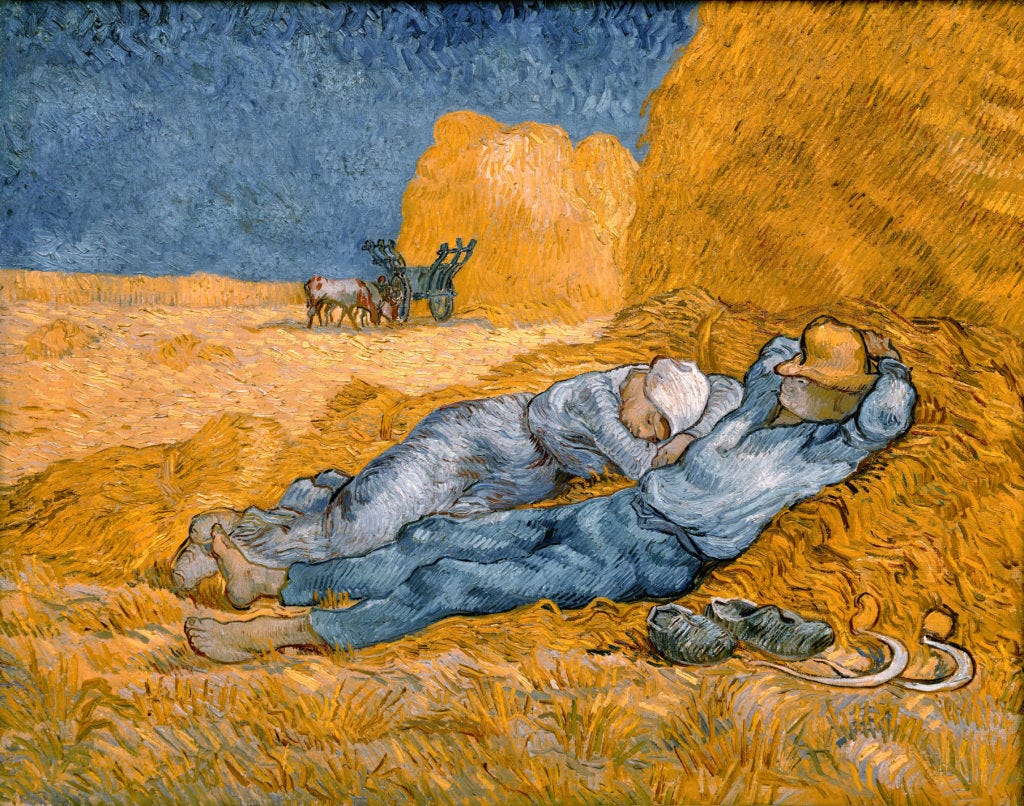
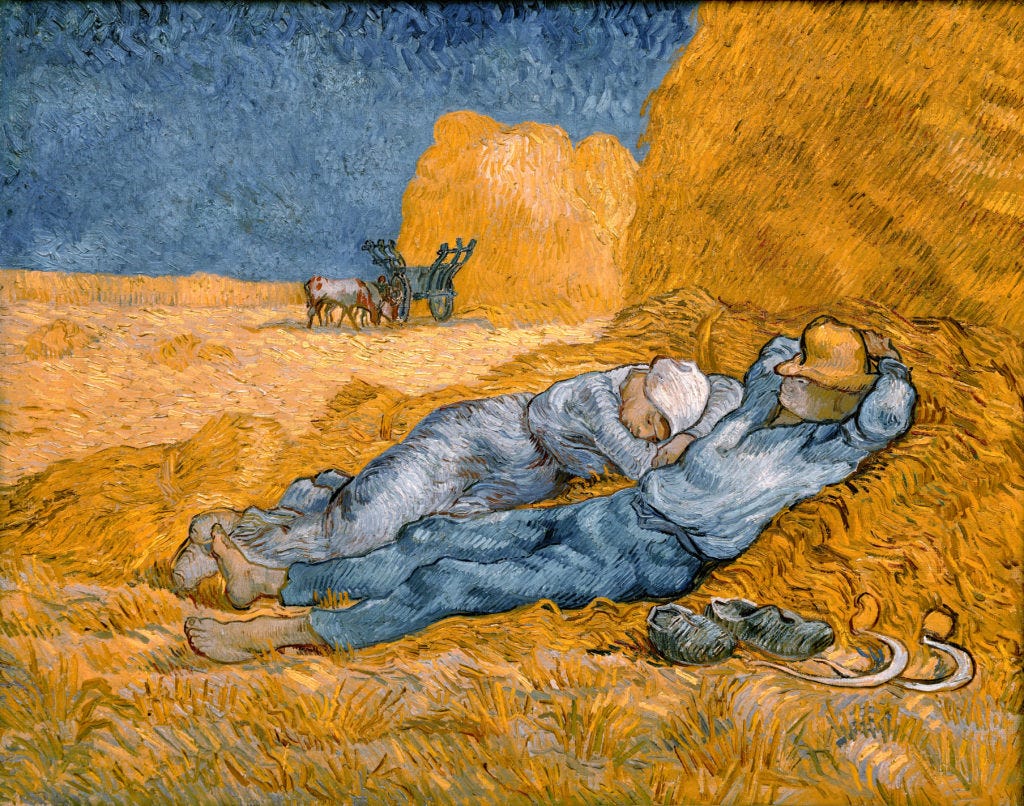
Vincent van Gogh, Noon Rest from Work after Jean-François Millet, 1890, Musée d’Orsay, Paris, France. Now, the imagery of heatwaves may begin to (re)define that collective imagination. It is still summer, but with a very different reality.
Artists who portray cultures accustomed to arid climates invite us into ways of living shaped by tradition. An adaptation, and a slower rhythm. What can we learn from communities that have long lived alongside scorching heat?
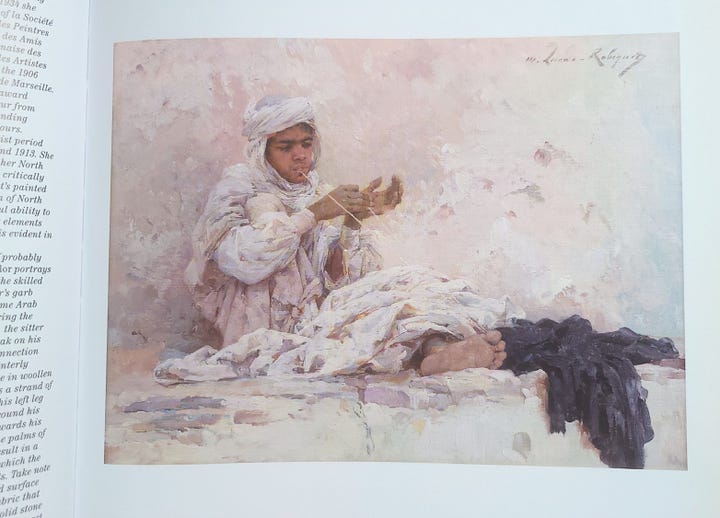
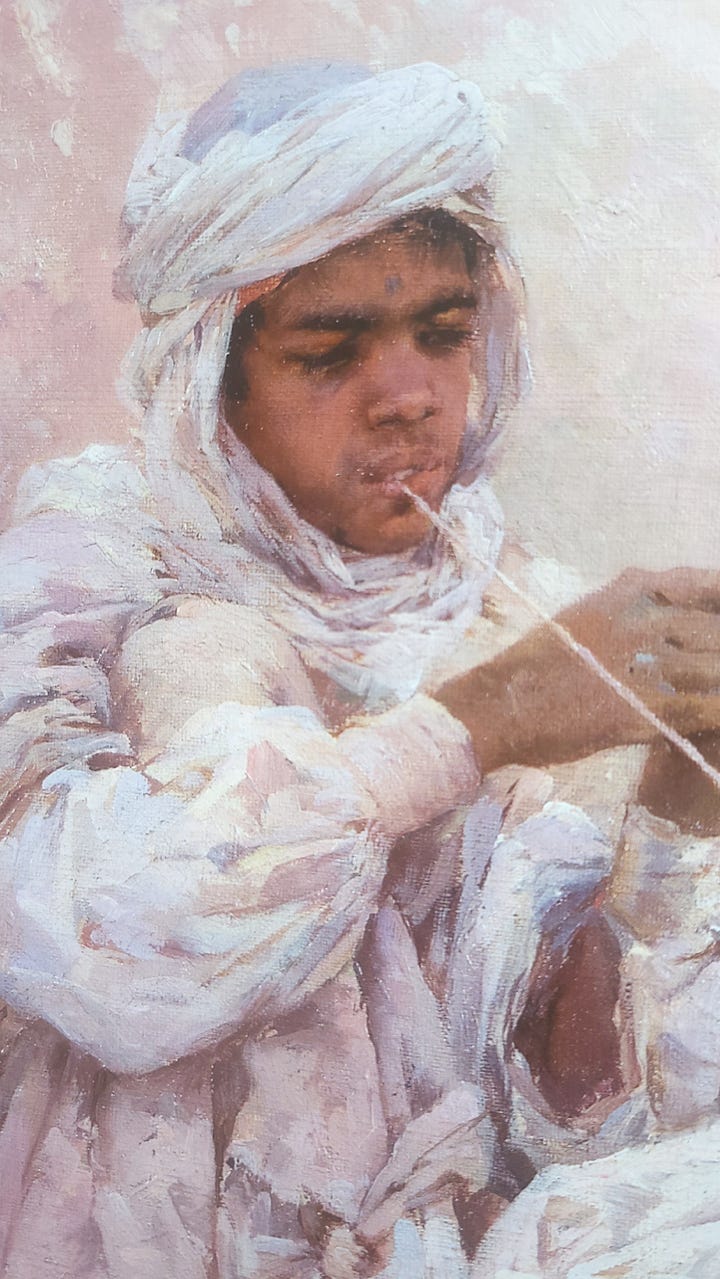
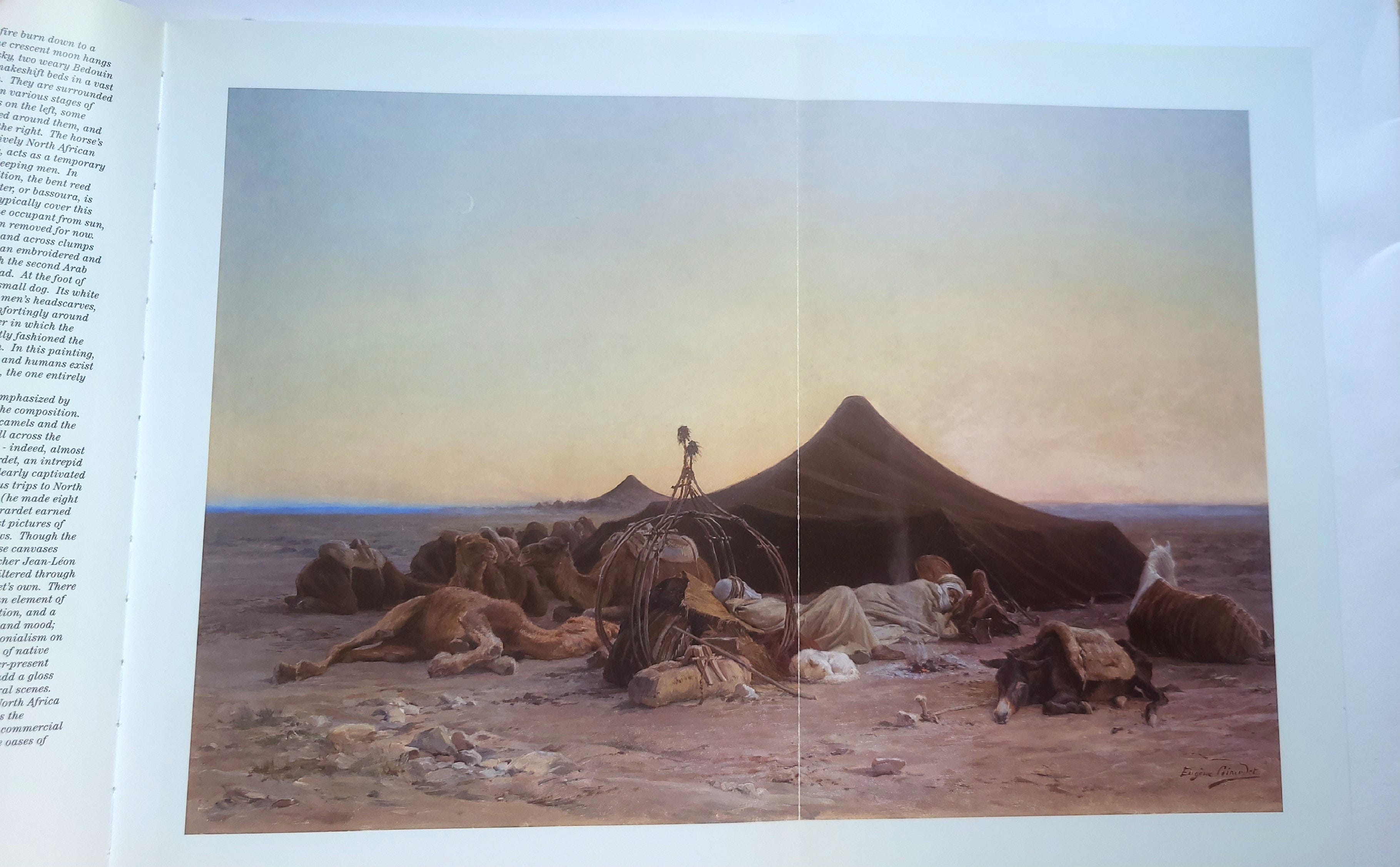
Marie Lucas-Robiquet. Le petit tailleur. (1858-1959). One of the few female voices in Orientalism. She travelled in Africa and captured lifestyles, traditions, and people. A picture from the Artcurial book. For this issue, I wanted to share an artist whose work captures that relationship with heat while conveying a profound sense of calm. I found exactly that in La Halte, an oil painting by Eugène Girardet. It is a scene of pause. A reminder that extreme heat slows life down, invites adaptation, and still leaves room for wonder. You can also grasp that from the detailed pastel painting Le petit tailleur by Marie Lucas-Robiquet.
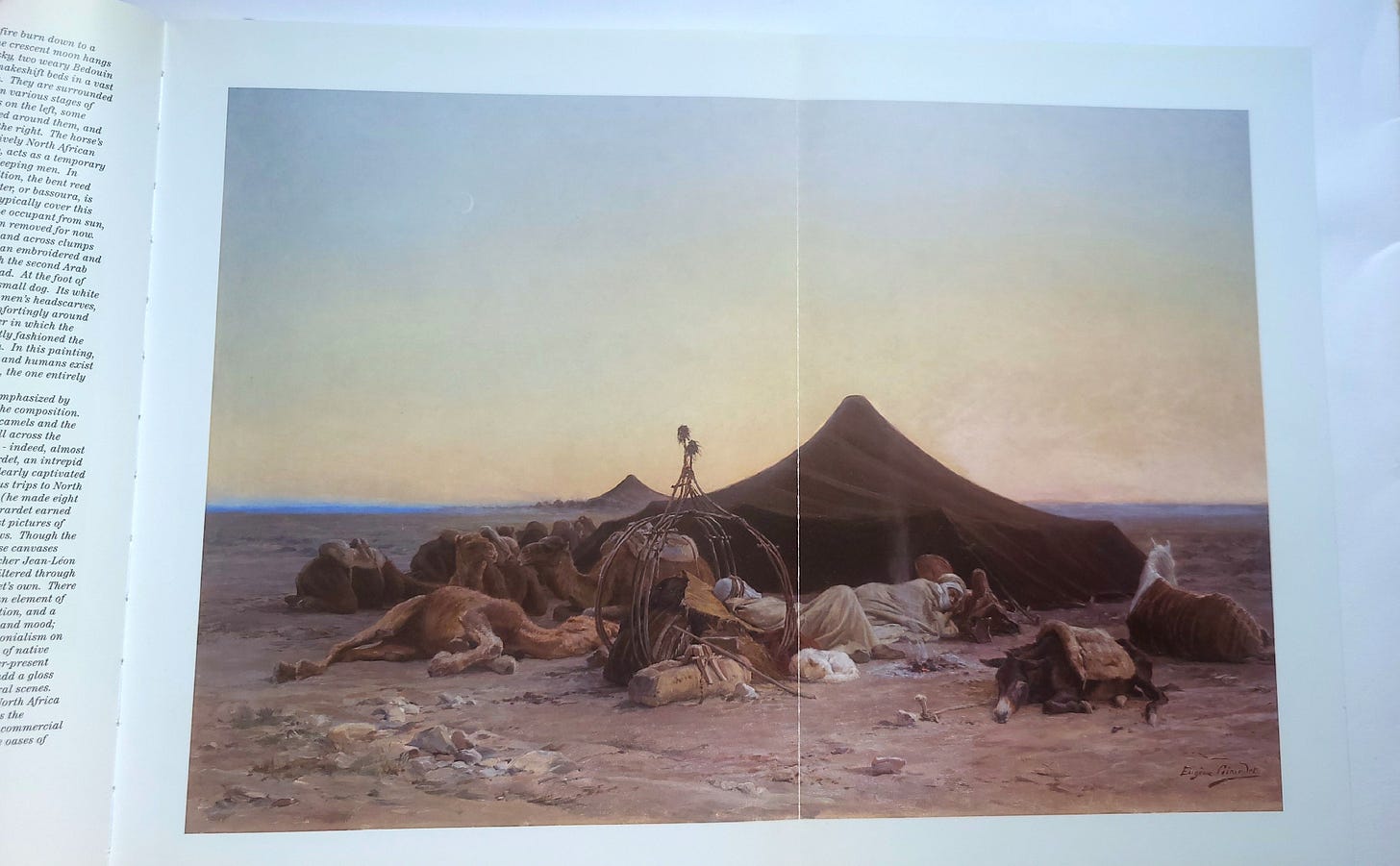
La Halte, an oil painting by Eugène Girardet (1853-1907). A picture of the painting in the Artcurial book.


❇️ Art of heat in techniques, vision, and sustainability
When your art is in the heat: Glass artists are the goats.
Slowly, letting the heat make the art. Time and the sun become the brush.
Art has the function to expose... conditions such as heatwaves.
✦ Elevating nature - artivism
How surprising it is to witness nature being elevated by people without destroying it, but rather exposing a new viewpoint. Artists who play with the land, within the land, and on the land have an advantage unlike any other. They are fully present, in sync with the material before them. They can only dance with it to create something beautiful and meaningful.
I recently discovered the work of Saype through a documentary, and I was immediately struck by the scale of his approach within nature. He creates large paintings on grass using a biodegradable paint of his own invention*. Treating the landscape not as a surface to erase but as a living canvas to collaborate with.
His work invites us to see the land differently and locates us within the land in a way we rarely experience. For a moment, we become one with nature, and the narrative shifts towards being guardians of the land.
Artivism is a term I have written about before, and I believe it represents a highway of opportunity for today’s and tomorrow’s creatives. Without invading a space forever, artists can sprinkle moments of awe for a few hours, days, or months, reminding us that we belong here, all of us.
*chalk, charcoal, water, casein (a milk protein), and natural pigments.
My idea was to paint directly in nature and have the biggest Art Gallery in the world, and it is a beautiful playground. Nobody did it before.
Saype
❇️ Artists who use nature as the canvas and brush
The flower carpet: An ode to nature, beauty, and in situ art.
10 surprising artists celebrating nature through their work.
Trompe l’œil with nature: Mulgil Kim invites us to merge with nature.

🤩 Creative awe
📺 When nature defends itself (Vincent Verzat is another artivist. He is a filmmaker and journalist. Since 2007, with his YouTube channel Partager c’est sympa, he has been raising awareness about climate change and social justice. In his documentary Le Vivant qui se défend, he invites us into the living world, encouraging us to observe nature from the ground up. He wants us to witness how plants, animals, and ecosystems coexist alongside us, and the price they pay for our ways of living. It is a powerful documentary that reminds us we are not separate from the living world. We are part of it. A must-watch!)
📊 House of Small is a blueprint (Thinking small might save us all. Rather than building businesses and systems driven by endless growth, Marcus Feldthus and Oscar Haumann advocate for local, sustainable solutions built from the ground up. They believe that meaningful change begins at the right scale. Creating a positive ripple effect that benefits the whole. Former consultancy founders turned sustainability experts, they developed the Economies of Small framework. A practical approach applicable to a wide range of industries for impact.)
👚Petit Pli is the creative fashion brand we need now (With rising temperatures, we must affirm what we wear and how long we keep it. From children’s clothing to adult wardrobes, Petit Pli is shaping the future with its long-term philosophy ‘‘Clothes That Grow With Your Child’’, becoming a value we can pass on as both a priority and a legacy. I am rooting for their innovations to make textiles cooler and more comfortable in extreme heat, and hopefully, they will become accessible to many more households.)
🌶️ Refreshing hot ones
Now that the temperatures are cooling down a little, we can spice things up again. Let’s turn the spotlight on the hot pepper culture. Heat is more than a trend. It is a cultural language, a ritual, and, for many people unfamiliar with spices, a true shock to the senses. I have been binge-watching Hot Ones for years, starting with the US version. I had never watched the French version. I watched this episode, which features Pierre Niney, who was magistral in this exercise. I have to say, it was good. As always, he turned the interview into an impromptu masterclass. This man can play anything. Give him an instruction, and he is on!
During the heated session, Pierre Niney describes childhood as the meeting point between innocence and boundless imagination. He argues that creativity isn’t something we discover later in life, but something we spend our lives trying not to lose. The greatest challenge of adulthood is protecting that small, yet fragile place where play, fantasy, and curiosity still exist.
Creativity is in every little curious experimentation.
Congrats, you made it to the hot end! I hope you enjoyed this voyage.
Take good care,
Keva.

Stay hydrated and cool, Keva!